How to Remove an Employer Review from Google Search
Defamatory, fake or policy-violating employer reviews on Glassdoor, Indeed, Comparably and Kununu can be challenged at the source and delisted from Google. Reviews that are merely negative but truthful are not removable — but we tell you that for free in the assessment. If you need to remove employer review from Google search results, we start with a free platform audit.
How to remove an employer review from Google
A fake or defamatory review on Glassdoor, Indeed or similar sites can dominate your company name in Google and scare off candidates and customers. These reviews often break the platform rules, which is your route to removal.
Report policy violations
Glassdoor and Indeed remove reviews that are fake, not from a genuine employee, defamatory, or that reveal confidential information. A clear, evidenced report is the first and often fastest step.
When the platform will not act
If a review is defamatory and the platform hesitates, a formal legal notice adds weight, and the review URL can be de-indexed from Google so it stops appearing in search.
Have us handle it
We report the violation, escalate through the right channels, and de-index the result from Google, protecting your employer brand and rating. Guaranteed within 10 days or your money back.
Can you remove an employer review from Google search?
Yes — but it is two jobs, not one, and only one kind of review comes down. The review has to be removed at the platform it lives on, and then the URL has to be cleared out of Google’s index, because a deleted page can keep returning your company name in results for weeks. What comes down is content that breaks a named platform rule or crosses a legal line. An honest, unflattering opinion from someone who genuinely worked for you does not, and no credible service will tell you otherwise.
Where employer reviews about you actually rank
Most companies discover the problem the same way: they search their own name and find a review site sitting directly beneath their careers page. Employer reviews rank well because the sites carrying them have enormous domain authority and because your company name is the exact query. These are the surfaces we check on every case.
Glassdoor
The one that ranks hardest for “[company] reviews” and the one with the strictest removal position. Glassdoor removes for Community Guidelines breaches, not for being negative, and it will not negotiate. Our dedicated guide covers the grounds in depth: how to remove a Glassdoor review.
Indeed company reviews
Often overlooked because employers watch Glassdoor, yet Indeed pages frequently outrank it for the company name. Indeed’s rules are in some respects stricter, and flagged content is reviewed within one to two business days — the fastest turnaround of any major employer platform.
Comparably, Kununu, Blind and regional sites
Smaller audiences, but they rank because almost nobody competes for the query, and they syndicate. Kununu dominates German-speaking markets, Blind carries anonymous tech posts, and regional job boards run their own review sections with their own rules.
Google reviews left by ex-staff
A former employee leaving a one-star review on your Google Business Profile is a different problem with a different fix: it breaches the conflict-of-interest and genuine-experience rules rather than any employment policy. See deleting a Google review.
Reddit, forums and social posts
A Reddit thread naming your company can outrank every review site, because the format is exactly what search engines now favour. These are removed on different grounds again — usually personal information, harassment, or a subreddit rule rather than a review policy.
Scraper and aggregator copies
Sites that republish review content wholesale, often with your company name in the page title. Removing the original does nothing to these, and they are frequently what is still ranking a month after the case looked finished.
The grounds that actually get an employer review removed
Employer review sites do not adjudicate whether a review is true. They check whether it breaks a rule they have written down. That is the whole game: a complaint arguing “this is unfair” is closed, and a complaint showing a specific guideline breach is actioned. These are the grounds that carry weight, and what each one needs from you.
| Ground | What it means in practice | Likelihood |
|---|---|---|
| The reviewer never worked for you | Reviews must be based on genuine, first-hand employment. A review describing a role you have never had, a site you do not operate, or a period predating the company is a genuine-experience breach — the strongest ground available and the easiest to evidence from HR records. | High |
| Stated as fact rather than opinion | Indeed requires reviews to be personal opinion and not presented as fact. “I found management disorganised” is protected. “This company falsifies its accounts” is an assertion of fact, and an assertion of fact that is false is both a policy breach and potentially defamatory. | High |
| Allegations of illegal activity or internal misconduct | Indeed prohibits claims of illegal activity and internal company misconduct outright. Many employers never realise this is a standing ground, and report the review as “false” instead — which is assessed against a rule the platform does not have. | High |
| Names an individual or shares personal details | Naming a manager, a colleague or any non-public individual, or including contact details, is prohibited on every major employer platform. It is also the fastest ground, because the breach is visible on the face of the review with no investigation required. | Very high |
| Confidential or commercially sensitive information | Client names, unreleased products, financial data, internal documents or anything covered by a confidentiality clause. This ground carries additional weight because it engages the reviewer’s own contractual obligations, not only the platform’s rules. | High |
| Discriminatory, threatening, abusive or obscene | Slurs, threats, sexual content and targeted abuse are removed on every platform. A review that is merely angry does not qualify; one that attacks a protected characteristic does. | High |
| Paid, incentivised or pressured | Both Glassdoor and Indeed prohibit reviews that were bought, solicited under pressure or posted on somebody else’s instruction. Relevant where a competitor or a disgruntled former director has organised a campaign. | Medium–High |
| Duplicate or repeat postings | Indeed permits one review per person per company. Where the same person has posted repeatedly under different accounts, the duplication itself is the breach — and it is provable from the writing style and timing without identifying anybody. | Medium–High |
| Genuine criticism from a real employee | Not removable, on any platform, by anybody. It can be answered, contextualised and outweighed, but a service promising to delete it is either lying or planning something that will cost you more than the review does. | Not removable |
What Glassdoor and Indeed actually do with your report
Both platforms publish how this works, and both are more rigid than employers expect. Understanding the constraints before you file is what separates a removal from a rejection you cannot appeal.
The legal routes, and what they can realistically achieve
A refusal is the end of the free process, not the end of the matter. Four routes remain, and which applies depends mostly on where you are and what the review actually says.
Defamation against the author, not the platform
In the United States, platforms are broadly shielded from liability for what users post, so demanding removal from the site on defamation grounds almost always fails. The claim lies against the person who wrote it. In the UK and much of Europe the balance differs, and a properly framed notice to the platform carries more weight.
Identifying an anonymous reviewer
Possible, but only through legal process — a subpoena in the US, a Norwich Pharmacal order in the UK. Employer platforms defend reviewer anonymity robustly and have litigated to do so. It is worth pursuing where one person is running a sustained campaign, and rarely worth it for a single review.
Data protection, where a person is named
If a review identifies an employee, the personal data of that individual is engaged and an erasure request becomes available in the UK and EU independently of the platform’s own rules. This is frequently the fastest legal route, and it is the one most commonly overlooked.
Confidentiality and contractual obligations
Where the reviewer disclosed client names, financial information or anything covered by a confidentiality clause, the obligation sits with them rather than the platform. A measured letter citing the specific clause resolves a surprising number of these without any filing at all.
Removing the review does not clear it from Google
Employer review pages are indexed like any other page, usually under a title containing your company name. Take the review down and that result can keep appearing — the old title, the old snippet, sometimes the star rating — for weeks, because nothing tells Google the page has changed. Two things have to happen, in order.
First: the content genuinely has to be gone
A review hidden behind a filter, or a profile set to private, is not a removed page. The index refresh only holds if the URL genuinely no longer returns the content. This is why suppression-only providers leave clients exposed: the result reappears the moment the page does.
Then: Google has to be told
Google’s Refresh Outdated Content tool exists for pages you do not own. Where the page is gone, the result drops out once the request is processed. Where the page survives but the review has been removed from it, the tool strips the stale snippet and refreshes it at the next crawl instead.
Expect days, and do not resubmit
Requests are processed in batches and several days is normal. Submitting the same URL repeatedly does not accelerate it, and submitting a URL where the content is still live gets the request denied and makes the next one slower.
Bing is a separate job
The same page is indexed independently by Bing, which feeds Copilot and parts of several AI assistants. Clearing Google and leaving Bing is how a review that everyone thought was dealt with resurfaces inside an AI answer a month later.
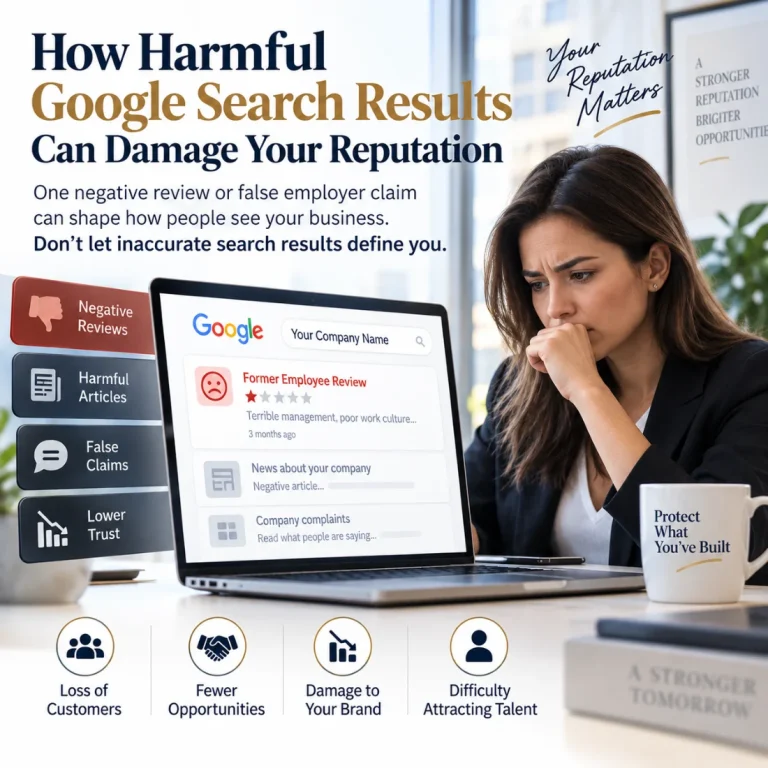
What one employer review costs you in hiring — and who else is reading it
Employer reviews are read at the precise moment someone is deciding whether to commit to you, and the damage is almost entirely invisible: nobody tells you they read it, and nobody tells you it is why they said no.
Candidates drop out before you meet them
Reading reviews is now a standard step before applying, not before accepting. The people you lose to a bad review are the ones who never entered your pipeline at all, which is why it never shows up in your recruitment reporting as a reputation problem.
Offers get declined, or cost more
A strong employer profile lets you hire at the salary you planned. A weak one means more declined offers, longer time-to-fill, more agency fees, and candidates who negotiate harder because they believe they are taking a risk on you.
Your existing staff read it too
Employees read reviews about their own employer, and a review naming a manager or a team does damage inside the business well before it costs you a hire. Retention problems frequently start on a page nobody in the company will admit to reading.
Clients, tenders and due diligence
Corporate buyers, procurement teams and investors check employer reputation as part of diligence, particularly where staff turnover affects delivery. An unanswered allegation of misconduct can quietly remove you from a shortlist without anybody raising it.
Candidates now ask AI first
“Is [company] a good place to work?” is one of the most common questions put to ChatGPT, Gemini, Perplexity and Copilot. The answer is assembled from indexed pages — review sites among them — and delivered as a confident paragraph with no star rating beside it and no page two to push anything on to.
It compounds while it sits there
A damaging review attracts agreement. It gets quoted in forum threads, screenshotted into group chats and cited by the next reviewer. The window in which a removal is clean and quiet is measured in weeks, not years.
How linkremovalfromsearch.com removes employer reviews
Most companies reach us after an in-house attempt has already been refused, which makes the second approach harder. We do this every day, across more than 60 countries, and we have been doing it since 2001. What you get is the whole job, run end to end and without anyone in your business having to contact a former employee.
We map what is actually ranking first
Before anything is filed we check what appears for your company name, your careers page and your leadership team, across Google and Bing. Clients are regularly surprised by which result is doing the damage.
We identify the ground, and tell you if there is none
The assessment is free and it happens before you commit to anything. If the review is genuine criticism that no platform will remove, we say so and explain what would actually help instead — we do not take cases we expect to lose.
We write and file the submission
One named guideline, the exact wording quoted, the breach made visible on the face of the review. Platforms assess what they can see rather than what you assert, so the submission is built around what they can verify without you.
We escalate on the right basis
Where guidelines are exhausted, the route changes rather than repeats: data protection erasure where an individual is named, a confidentiality demand where information was disclosed, or defamation against the author where something false was stated as fact.
We clear the result from Google and Bing
Removal at source is half the job. We submit the dead or changed URL for refresh on both engines, so the cached snippet carrying your company name stops appearing and the AI assistants reading it have nothing left to read.
Entirely confidential, and no contact with your staff
Nothing is filed publicly in your company’s name, there is no visible footprint tying the removal back to you, and an NDA is available on request. No current or former employee is ever approached.
Employer review removal — straight answers
Can an employer get a Glassdoor or Indeed review removed?
Will Glassdoor remove a review because we say it is false?
How long does employer review removal take?
Can we find out who wrote an anonymous employer review?
Can we sue Glassdoor or Indeed over a defamatory review?
Should we ask the employee to take the review down?
Can a review that names one of our managers be removed?
The review was deleted but it still shows in Google. Why?
Can a competitor or ex-director post fake reviews about us?
Do employer reviews affect what AI assistants say about us?
Are Glassdoor and Indeed reviews really anonymous?
Do paid review-removal services actually work?
Can we turn off reviews or delete our company profile?
Do old employer reviews eventually expire?
Can we ask happy employees to post reviews to balance it out?
What happens to our reviews if we rebrand or get acquired?
Can a review from a contractor, agency worker or job candidate be removed?
How can we tell whether a review is fake or from a real employee?
One harmful URL on Google can quietly cost you more than you realise.
Before a client signs, an investor wires the funds, a partner introduces you, a date opens an app — they Google you first. A single defamatory article, leaked document, fake review or outdated court record can close doors you never even knew were open. Link Removal From Search exists to delete those URLs permanently from Google and every connected surface.
Fake or policy-violating reviews on Glassdoor, Indeed and Comparably can surface directly in Google results. We combine platform-policy complaints, verified-employment disputes and direct outreach to remove employer reviews from Google search listings — without touching genuine employee feedback.
For guidance on identifying policy-violating content, see Google’s search removal troubleshooter, which we use alongside platform reports.
Every category of URL we delete at source — then delist from Google.
We remove URLs two ways: completely deleting the page at the source (publisher, host, platform takedown), then delisting it from Google Search, Images, AI Overviews and every connected surface. Both layers, one flat fee. We remove employer review from Google search content tied to fake or competitor-posted reviews.
Defamatory Content
Libel, slander, false accusations, fabricated news articles and malicious blog posts removed under defamation and tort law worldwide. Our team can remove employer review from Google search listings involving former-employee disputes.
Copyright (DMCA)
Stolen images, leaked documents, pirated videos, plagiarised articles and any unauthorised reproduction of your owned work. HR teams ask us to remove employer review from Google search results before major hiring campaigns.
Personal Information
Home addresses, phone numbers, ID documents, banking details, medical records and other PII under Google’s “Results about you” policy. Every case to remove employer review from Google search content is reviewed against platform policy.
Doxxing
Leaked addresses, family information, daily routine maps and any data weaponised to threaten you or your household. We also remove employer review from Google search entries linked to defamatory or false claims.
Fake Reviews
One-star bombing campaigns, competitor sabotage, false complaints and unverifiable negative ratings on Google, Trustpilot, Yelp and beyond. Clients who remove employer review from Google search content with us see results within 5 business days.
Outdated Records
Old news articles, expunged or sealed court records, dismissed charges and outdated press that no longer reflect reality. We remove employer review from Google search content across Glassdoor, Indeed, and Comparably alike.
Scam & Impersonation
Fake websites impersonating your brand, scam pages, fraudulent profiles and cloned accounts directing traffic to fraud. Our process to remove employer review from Google search listings includes ongoing monitoring afterward.
RTBF / GDPR
Right-to-be-forgotten delisting requests under GDPR Article 17, UK DPA, LGPD, CCPA, Indian DPDP Act and equivalent frameworks. We remove employer review from Google search results tied to coordinated review-bombing campaigns.
From URL submission to permanent deletion — usually inside 10 days. The page is gone from the source AND from Google.
A clear, four-step process. You stay informed at every stage. We do the technical work, the legal correspondence and the platform escalation. Companies ask us to remove employer review from Google search content before IPOs and acquisitions.
Send Us the URL
Share the Google search result hurting you. We accept screenshots, search-result links and direct URLs. WhatsApp or the form above — both arrive in the same inbox. Start today if you need to remove employer review from Google search — most cases begin within 24 hours.
Free Removal Audit
Within 24 hours we identify the strongest removal route — DMCA, defamation, GDPR, platform policy — and send a clear, flat-fee quote with timeline.
File & Escalate
We submit every required notice to host, platform and Google directly. If the host refuses, we escalate to upstream networks, registrars, payment processors and counsel.
Proof + Monitoring
You receive a complete removal report showing the source URL gone (404 / dead-host proof) and the Google SERP cleared. We monitor for 12 months and re-file instantly if the URL or any near-duplicate resurfaces anywhere online.
Four proven channels — for complete source removal and Google delisting.
The right route depends on the URL’s content, your jurisdiction, and the platform hosting it. We assess every case for the strongest available angle.
Complete URL removal and Google delisting — in every major jurisdiction.
Google’s legal-removal channels are jurisdiction-aware — we file under the strongest applicable framework for each client’s country.
Google link removal — straight answers.
How do I remove a Glassdoor or Indeed review from Google?
Can I sue an ex-employee for a fake Glassdoor review?
Will Glassdoor remove a negative review just because we ask?
What evidence do I need to challenge a fake review?
Can I respond to the review instead of removing it?
How long does employer-review removal take?
Does removal affect our overall company rating?
How much does it cost to remove an employer review from Google?
Can I remove a fake employer review?
Will Glassdoor remove a defamatory review?
How do I remove an employer review from Google search?
How long does employer review removal take?
We delete the content at its source — not just from Google
Link Removal From Search does not simply hide a result. We remove the original post, video, article or page from the platform where it lives. Once the source is gone, it disappears from Google, Bing, DuckDuckGo — and from AI answers in ChatGPT, Gemini, Copilot, Grok and Google AI Overviews, because there is no longer a source for them to cite.
Where deletion is not possible, we pursue de-indexing, content updates or corrections at the source — updated sources are re-crawled quickly, which is what keeps AI search results clean and current.
Browse all link & URL removal services
Pick the problem you face or the country you need help in. Every page covers complete URL removal at the source plus Google delisting.
Core service
By content type
Get a Free Removal Assessment
Send us the harmful URL. We’ll come back with a clear plan, the legal route, and a flat-fee quote — usually within 24 hours.