

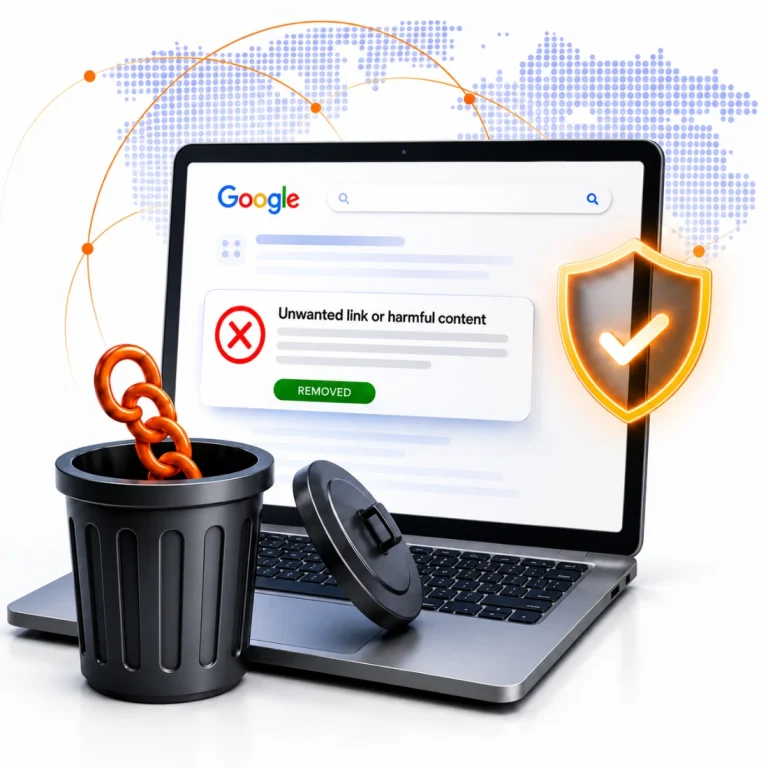
We don’t hide the link — we delete the content at its source.Defamatory articles, leaked documents, doxxing, fake reviews and outdated records — removed from the site that hosts them, then delisted from Google, Bing and AI search. Most cases resolved in 10 days.
Link Removal from Search is a specialist content removal service that deletes harmful web pages at their source and clears them from Google, Bing and AI search. A standard Google delisting request only hides a URL while the original page stays live, so it can resurface and be re-indexed later. We remove the underlying content itself, which is why the result is permanent rather than cosmetic.
We handle the full range of online reputation and privacy problems: defamatory articles, leaked or personal information, doxxing, fake or negative reviews, outdated news and court records, mugshots and arrest records, scam and impersonation pages, and non-consensual images. Where the law supports it, we use DMCA takedowns, defamation law and the Right to be Forgotten (GDPR and the UK Data Protection Act) to secure permanent removal at the source.
Because the original page is gone, the content also disappears from AI answers in ChatGPT, Google AI Overviews, Gemini, Copilot and Perplexity, which cite live web pages to build their responses. Most cases are resolved within days, we work with clients in 60+ countries, and every removal is backed by a money-back guarantee — you only pay once you approve.
If you’re dealing with unwanted content appearing in search results, you’re not alone. Our specialist team handles hundreds of cases each year, helping individuals and businesses achieve a cleaner online presence.
Every case is different. The right approach depends on what type of content is involved, where it’s hosted, and what outcome you need. We start every engagement with a thorough assessment before recommending any action.
From direct removal requests to legal notices, Google delisting, and strategic suppression, we apply the most effective tools available. Our team has specialist knowledge of both UK law and the technical workings of search engines.
The sooner you act on a reputation problem, the more options you have. Contact us for a free, confidential assessment of your situation and honest advice on what’s achievable.
Before a client signs, an investor wires the funds, a partner introduces you, or someone simply searches your name, they find what’s already public. A defamatory article, a leaked document, a fake review or an outdated court record doesn’t just rank on Google — it exists, permanently, on the site that published it. Delisting a search result treats the symptom. We treat the cause: Link Removal From Search exists to remove that content at its source, whenever legally possible, so it stops being available to Google, Bing, AI search and anyone who finds it directly.
Link Removal From Search does not simply hide a result. We remove the original post, video, article or page from the platform where it lives. Once the source is gone, it disappears from Google, Bing, DuckDuckGo — and from AI answers in ChatGPT, Gemini, Copilot, Grok and Google AI Overviews, because there is no longer a source for them to cite.
Every platform has its own reporting process, evidentiary standard and escalation path. Here is how we approach the ones we handle most often:
Videos, comments and entire accounts removed through TikTok’s Trust & Safety and legal escalation channels, covering harassment, impersonation and non-consensual content.
Videos, channels and livestream recordings removed under YouTube’s copyright, privacy and harassment policies, escalated directly with Google’s Trust & Safety team when standard reporting stalls.
Posts, threads and full profiles removed under X’s abuse, doxxing and non-consensual media policies, with direct escalation to X’s legal and safety teams for high-risk cases.
Posts, pages, groups and profiles removed through Meta’s community standards and legal request channels, covering harassment, impersonation and doxxing.
Threads, comments and posts removed via Reddit’s site-wide policies and, where standard reporting fails, direct legal takedown requests to Reddit’s admin team.
Posts, reels, stories and full profiles removed under Meta’s harassment, impersonation and privacy policies, using the same escalation path as Facebook.
Published articles and blog posts removed or corrected directly with the publisher, editor or webmaster — the most effective route for defamation and outdated coverage.
Threads, complaints and reviews removed from forums and review platforms such as Trustpilot, Glassdoor and Ripoff Report, each filed to that platform’s specific evidentiary standard.
These eight categories cover the large majority of cases we handle, but they are not the limits of what we pursue. Where full deletion is not legally possible on a given platform, we pursue the next-strongest available route: de-indexing, a corrected or amended version at the source, or a formal platform policy escalation. An updated or removed source is what search engines and AI systems re-crawl and reflect fastest.
Search engines are not the only way content resurfaces. If the original page is still online, it can be reshared, rediscovered, recrawled, or referenced by an AI system, regardless of what Google currently shows. Here is the practical difference between the two approaches.
This is why we position ourselves as a content removal company, not a delisting company. Delisting is often a step in the process — it is never the destination.
Most services only hide URLs from Google. We go further — we delete the page at the source (publisher, host, platform takedown), then delist it from Google Search, Images, AI Overviews and every connected surface. Both layers, one flat fee.
Libel, slander, false accusations, fabricated news articles and malicious blog posts removed under defamation and tort law worldwide.
Stolen images, leaked documents, pirated videos, plagiarised articles and any unauthorised reproduction of your owned work.
Home addresses, phone numbers, ID documents, banking details, medical records and other PII under Google’s “Results about you” policy.
Leaked addresses, family information, daily routine maps and any data weaponised to threaten you or your household.
One-star bombing campaigns, competitor sabotage, false complaints and unverifiable negative ratings on Google, Trustpilot, Yelp and beyond.
Old news articles, expunged or sealed court records, dismissed charges and outdated press that no longer reflect reality.
Fake websites impersonating your brand, scam pages, fraudulent profiles and cloned accounts directing traffic to fraud.
Right-to-be-forgotten delisting requests under GDPR Article 17, UK DPA, LGPD, CCPA, Indian DPDP Act and equivalent frameworks.
People increasingly find information through ChatGPT, Google AI Overviews, Gemini, Claude, Microsoft Copilot, Perplexity and Grok, not only through a traditional search results page. Several of these systems browse the live web to answer questions, citing sources in real time, which means the same original page that ranks on Google can also be the source an AI assistant references.
Removing that page at its source addresses both at once, in a way that delisting alone cannot: once the original content is gone, there is nothing left for a search engine to index or an AI system’s live web search to retrieve and cite going forward.
The original source is the foundation everything downstream depends on. Remove the foundation, and there is less, and eventually nothing, for search engines or AI systems to find.
A clear, four-step process. You stay informed at every stage. We do the technical work, the legal correspondence and the platform escalation.
Share the content that’s hurting you — a URL, a screenshot, or a search result. WhatsApp or the form above — both arrive in the same inbox.
Within 24 hours we identify the strongest removal route — DMCA, defamation, GDPR, platform policy — and send a clear, flat-fee quote with timeline.
We submit every required notice to host, platform and Google directly. If the host refuses, we escalate to upstream networks, registrars, payment processors and counsel.
You receive a complete removal report showing the source URL gone (404 / dead-host proof) and the Google SERP cleared. We monitor for 12 months and re-file instantly if the URL or any near-duplicate resurfaces anywhere online.
The right route depends on the URL’s content, your jurisdiction, and the platform hosting it. We assess every case for the strongest available angle.
Google’s legal-removal channels are jurisdiction-aware — we file under the strongest applicable framework for each client’s country.
Most removal services only think about Google. But Bing, and the engines built on it including Microsoft Copilot, indexes the same public web. Filing a Google-only delisting request leaves the original page live for Bing to crawl, rank and continue to surface. Because our approach removes the content at its source rather than delisting it one search engine at a time, Bing loses the same page Google does, without a second, separate removal process. Where a source cannot be fully removed, we file the matching Bing content-removal request alongside every other engine, so no single platform is left showing what the others no longer do.
Increasingly, people search reputations through AI tools rather than a search bar, asking ChatGPT, Google AI Overviews, Gemini or Perplexity directly about a person or company. These tools frequently answer by browsing and citing live web pages, which means a harmful article can resurface in an AI-generated answer even if it no longer ranks on page one of Google.
We approach AI search reputation management the same way we approach everything else: by removing the underlying source page whenever legally possible, so there is nothing live left for these tools to retrieve. Where a platform offers a direct data or content opt-out process, we file that in parallel. We do not promise instant or guaranteed removal from any AI system, no legitimate provider can, but source removal is, today, the most effective lever available for reducing what these tools can find and cite.
Most competitors sell a delisting request. We sell an outcome.
Not a delisting shortcut. We only fall back to search-engine-only removal when source removal genuinely is not available.
Active removal experience across 60+ countries and every major legal framework — US, UK, EU/GDPR and equivalents elsewhere.
One point of contact for your case from start to finish, not a rotating support queue.
NDA available on request. Your identity is protected wherever the law allows it.
Every notice is drafted in-house to each platform’s specific evidentiary standard.
The legal basis and the technical execution — hosting, DNS, platform escalation — are handled by the same team, not handed off between departments.
Every case is reviewed individually — the right legal route depends on who you are, what was published, and where.

Pick the problem you face or the country you need help in. Every page covers complete URL removal at the source plus Google delisting.
That is not a small thing to ask. So before you send a link, here is exactly who you are dealing with and what we are bound to.
Every removal goes through the proper legal or platform route — copyright, privacy, defamation, the right to be forgotten. That is slower than a trick, and it is why the removals hold instead of unravelling months later.
Every case is 100% confidential and we sign an NDA on request. One dedicated specialist handles your case from start to finish — nothing is outsourced — and we never see your card.
You get a fixed quote within 24 hours and decide from there. No win, no fee: if the content does not come down, you do not pay, backed by a 100% money-back guarantee.
We remove the content where it actually lives, then clear the copies from Google, Bing and AI answers like ChatGPT, Gemini and Perplexity. Gone at the source, not pushed to page two.