Facebook Post Removal Service – Remove Harmful Posts
Last updated · Reviewed by the Link Removal from Search team
Need to remove a Facebook post that is damaging your name or your business? We get the Facebook post, profile, page or group content deleted at the source — not just delisted from Google — every route covered.
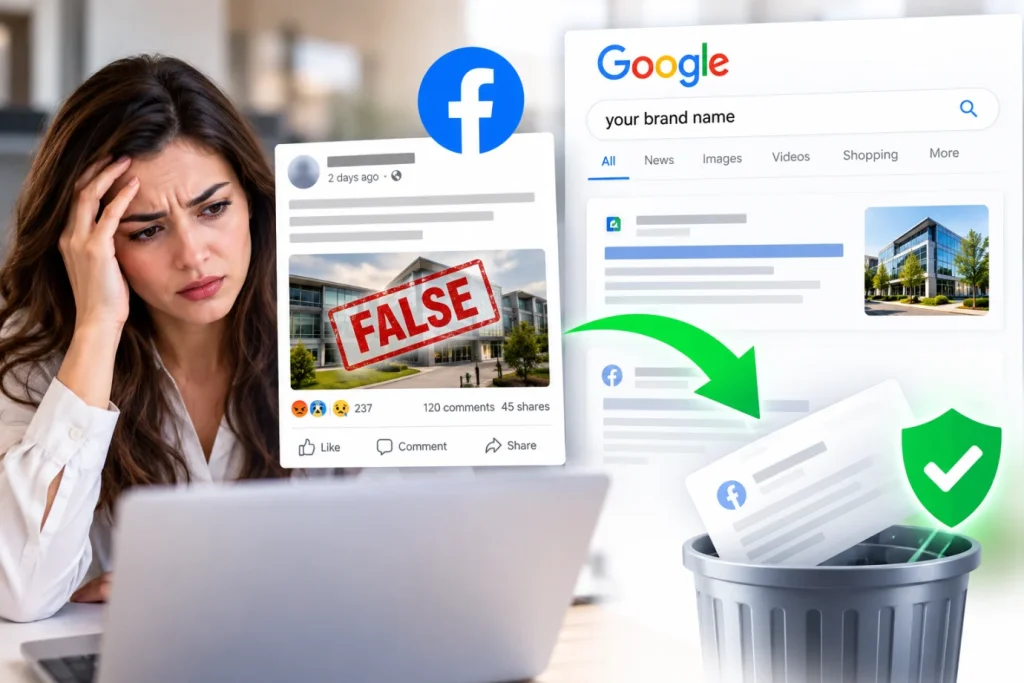
Remove a Facebook Post
If you’re dealing with unwanted content appearing in search results, you’re not alone. Our specialist team handles hundreds of cases each year, helping individuals and businesses achieve a cleaner online presence.
Understanding Your Options
Every case is different. The right approach depends on what type of content is involved, where it’s hosted, and what outcome you need. We start every engagement with a thorough assessment before recommending any action.
What We Can Do
From direct removal requests to legal notices, Google delisting, and strategic suppression, we apply the most effective tools available. Our team has specialist knowledge of both UK law and the technical workings of search engines.
Take the First Step
The sooner you act on a reputation problem, the more options you have. Contact us for a free, confidential assessment of your situation and honest advice on what’s achievable.
One harmful URL on Google can quietly cost you more than you realise.
Before a client signs, an investor wires the funds, a partner introduces you, a date opens an app — they Google you first. A single defamatory article, leaked document, fake review or outdated court record can close doors you never even knew were open. Link Removal From Search exists to delete those URLs permanently from Google and every connected surface.
Every category of URL we delete at source — then delist from Google.
We remove URLs two ways: completely deleting the page at the source (publisher, host, platform takedown), then delisting it from Google Search, Images, AI Overviews and every connected surface. Both layers, one flat fee.
Defamatory Content
Libel, slander, false accusations, fabricated news articles and malicious blog posts removed under defamation and tort law worldwide.
Copyright (DMCA)
Stolen images, leaked documents, pirated videos, plagiarised articles and any unauthorised reproduction of your owned work.
Personal Information
Home addresses, phone numbers, ID documents, banking details, medical records and other PII under Google’s “Results about you” policy.
Doxxing
Leaked addresses, family information, daily routine maps and any data weaponised to threaten you or your household.
Fake Reviews
One-star bombing campaigns, competitor sabotage, false complaints and unverifiable negative ratings on Google, Trustpilot, Yelp and beyond.
Outdated Records
Old news articles, expunged or sealed court records, dismissed charges and outdated press that no longer reflect reality.
Scam & Impersonation
Fake websites impersonating your brand, scam pages, fraudulent profiles and cloned accounts directing traffic to fraud.
RTBF / GDPR
Right-to-be-forgotten delisting requests under GDPR Article 17, UK DPA, LGPD, CCPA, Indian DPDP Act and equivalent frameworks.
From URL submission to permanent deletion — usually inside 10 days. The page is gone from the source AND from Google.
A clear, four-step process. You stay informed at every stage. We do the technical work, the legal correspondence and the platform escalation.
Send Us the URL
Share the Google search result hurting you. We accept screenshots, search-result links and direct URLs. WhatsApp or the form above — both arrive in the same inbox.
Free Removal Audit
Within 24 hours we identify the strongest removal route — DMCA, defamation, GDPR, platform policy — and send a clear, flat-fee quote with timeline.
File & Escalate
We submit every required notice to host, platform and Google directly. If the host refuses, we escalate to upstream networks, registrars, payment processors and counsel.
Proof + Monitoring
You receive a complete removal report showing the source URL gone (404 / dead-host proof) and the Google SERP cleared. We monitor for 12 months and re-file instantly if the URL or any near-duplicate resurfaces anywhere online.
Four proven channels — for complete source removal and Google delisting.
The right route depends on the URL’s content, your jurisdiction, and the platform hosting it. We assess every case for the strongest available angle.
Can you remove a post from a Facebook group?
Short answer: Yes — and group posts are one of the most common cases we handle. Only the author, the group’s admins and moderators, or Meta can delete a post inside a group, so a removal succeeds by reaching whichever of those three will act. We pursue all three.
A post inside a group behaves differently from a post on a profile or a page. That changes both how visible it is and who holds the power to delete it — which is why the ordinary advice about reporting a post so often goes nowhere.
What we do: we approach the group’s moderation team where that is realistic, file under the exact Meta policy the post breaches where it is not, escalate through legal channels where the content is unlawful, and then clear the cached result from Google so the thread stops returning for your name.
Complete URL removal and Google delisting — in every major jurisdiction.
Google’s legal-removal channels are jurisdiction-aware — we file under the strongest applicable framework for each client’s country.
Google link removal — straight answers.
Can I remove content myself?
Is professional content removal legal?
How long does removal take?
Do I need a lawyer?
Will the original publisher know I reported the URL ?
Can you remove links that are protected by the First Amendment?
How much does Google link removal cost in your country?
Do you also remove links from US AI tools like ChatGPT and Perplexity?
Can you remove a post from a Facebook group?
Will a Facebook group post show up on Google?
Can I get a group post removed if the admin refuses?
Does deleting a Facebook post remove it from Google?
Will the person who posted it know that I reported it?
Can you remove a Facebook post that is simply unfair?
Removed from Facebook at the source
Whether it is a defamatory post, a fake profile impersonating you, a harassment page or a group thread, hiding it from Google leaves it live for everyone on Facebook. We pursue removal at the source through Meta’s legal, privacy and IP channels — defamation, impersonation, harassment, and copyright for your stolen photos — so the content itself is gone.
How do I remove a Facebook post?
Short answer: Only three parties can take a Facebook post down: the person who wrote it, an admin or moderator if it sits inside a group, or Meta itself after a successful report. Every other route — privacy complaint, copyright claim, legal notice — works by persuading one of those three to act.
Which route you file under decides whether the post comes down or the report is closed with no action. Work down this list and stop at the first one that genuinely describes your situation.
You wrote the post
Delete it, or change its audience. Changing the audience to Friends takes it out of public view and out of Google, but the post still exists and everyone tagged can still see it. Only deletion kills the URL.
Report a Community Standards breach
In-app reporting is judged against a published Community Standards rule — harassment, bullying, threats, hate speech, adult content, impersonation. Report the rule the post actually breaks, not the post you dislike. This is the single most common reason a report fails.
Report a privacy violation
Meta removes personal information such as a home address, a phone number, an identity document or financial and medical records when the person affected reports it under its privacy violations policy — and images of a private individual posted without their consent.
File an intellectual property claim
If you took the photograph or filmed the video, copyright is the strongest tool available, because it obliges Meta to act rather than exercise judgement. The catch is ownership: the right belongs to whoever operated the camera, not to whoever appears in the shot.
Use the legal route
Where a post is defamatory or otherwise unlawful where you live, a formal legal notice or court order goes through Meta’s legal channel. In the EU the Digital Services Act also entitles you to a statement of reasons when Meta declines, an appeal, and an out-of-court dispute settlement body.
Why does a deleted Facebook post still show on Google?
Short answer: Because Google is showing its own stored copy, not the live post. It keeps the URL, title and snippet in its index, so a deleted post can keep returning a result for days or weeks until Google re-crawls the address and finds nothing there.
Removal is two jobs, in order. The post has to die at the source, and then the index has to be told. Doing only the second is what suppression services sell, and it fails the moment the page comes back.
What will Facebook actually remove — and what it will not?
Short answer: Meta removes content that breaks a named rule, not content that is merely unwelcome. Impersonation, published personal data, your own copyrighted images and clear harassment have strong grounds. An opinion, a bad word about you, or a true account of something that happened does not.
Knowing which side of that line your post sits on is what decides the strategy — and it is the part most removal services will not tell you before taking payment.
| Ground | What Meta needs from you | Likelihood |
|---|---|---|
| Impersonation of you or your business | Proof of identity, and a post or account presenting itself as you | High |
| Your home address, phone number or ID document published | The post itself, and that you are the person identified | High |
| A photo or video you created, posted without permission | Proof that you took it — ownership, not appearance | High |
| An image of you as a private individual, shared without consent | Your own report, as the person depicted | Medium to high |
| Harassment, threats or bullying | The exact wording, and the pattern where there is one | Medium |
| Defamation | A legal notice identifying the false statements of fact | Varies by country |
| An opinion, a criticism or a true account | — | Low — no rule requires it |
If the post is true or is an opinion, no platform rule compels its removal. That does not leave you with nothing: the removable edges are often still there — personal data inside the post, a copyrighted photograph, an impersonating account — and the URL itself can still be cleared from search.
How long does it take to remove a Facebook post?
Short answer: Meta publishes no service level, so anyone quoting you a guaranteed platform turnaround is inventing it. In practice an admin removal takes hours, an in-app report days, a privacy or copyright complaint days to about two weeks, and a legal route weeks. Clearing Google afterwards is the fast part.
These are working timeframes, not marketing ones. Where no service level exists we say so, because a timeline that is invented is useless the moment your case stalls.
| Route | Typical time to a decision | What slows it down |
|---|---|---|
| The author deletes it | Immediate | Nothing — but you have to persuade them |
| A group admin removes it | Hours to a few days | An inactive, unwilling or implicated admin |
| In-app Community Standards report | Days | Reporting the wrong rule, or not quoting the exact wording |
| Privacy or personal-information report | Days to about two weeks | Weak proof that you are the person identified |
| Intellectual property claim | Days to about two weeks | Ownership a reviewer cannot verify quickly |
| Legal notice or court order | Weeks | Jurisdiction, and whether the statement is fact or opinion |
| Google index refresh after removal | About 24–48 hours | The URL still resolving to a live page |
Who is allowed to ask for a Facebook post to be removed?
Short answer: Privacy and likeness complaints are first-person rights — they belong to the person in the post, not to whoever is angry about it. Copyright belongs to whoever created the image or video. Filing as the wrong party is one of the most common reasons a report is closed without action.
This technicality sinks more cases than any argument about the content itself. Here is who can file what.
| Who you are | What you can file |
|---|---|
| You, an adult identified in the post | Privacy, likeness, harassment and impersonation reports |
| Parent or legal guardian of a minor shown in the post | Privacy and safety reports on the child’s behalf |
| An authorised legal representative | Legal notices and complaints on your client’s behalf |
| A close family member of someone who has died | Memorialisation and certain removal requests |
| The photographer or film-maker | Copyright, regardless of who appears in the shot |
| A company whose brand or trade mark is used | Impersonation and trade mark complaints |
| A friend, colleague or bystander | Community Standards reports only — not privacy claims |
Benefits of choosing Linkremovalfromsearch.com — Facebook content removal service
Short answer: You get both halves of the job done by one team — the Facebook post deleted at source, and the stale result cleared from Google search — handled by specialists who have worked in online reputation management since 2001, on a no win, no fee basis. You pay for the outcome, not the attempt.
Most services that claim to remove a Facebook post do one of two things: they report it and hope, or they bury it under new content and call that a result. Neither deletes anything. Our Facebook content removal service is built the other way round — the post has to stop existing, and only then do we clear the cached result from Google so the URL stops returning for your name.
Deleted at source, not hidden
We remove the Facebook post, comment, photo, Page review or group thread itself. Suppression pushes a URL to page two; the moment it is shared again, it is back. Deletion is permanent.
Google delisting included
Deleting the post is only half the job. We also clear the stale entry from Google search, so the old title and snippet stop returning for your brand or your name — usually within days of the source going down.
Group and Page posts covered
Linkremovalfromsearch.com can remove Facebook group posts, including threads in public and private groups, as well as Page posts, reviews, recommendations and comment replies. Most providers will not touch group content at all.
No win, no fee
If the Facebook content is not removed, you do not pay. That single term does more to align our interests with yours than any guarantee page, and it is why we turn down cases we do not believe we can win.
Discreet from start to finish
No public filings where they can be avoided, no press, no response that draws a second wave of attention to the original post. Quiet removal is the whole point of hiring a specialist rather than replying in the thread.
Whether it is a defamatory Facebook post ranking on your company name, a leaked photo, a hostile group thread about your business, or a fake profile impersonating a director, the route is the same: establish the legal or policy ground under the strongest jurisdiction available to you, remove the content at source, then clear the search result behind it.
Can harmful Facebook posts affect customer trust?
Short answer: Yes. A harmful Facebook post that ranks on your brand name reaches people at the exact moment they are deciding whether to buy, hire or sign — and because it sits on a platform they already trust, most readers treat it as a report rather than as one person’s opinion.
The damage is rarely the post itself. It is the position the post occupies. A complaint on Facebook that nobody finds is a bad afternoon; the same complaint sitting third on Google for your company name is a permanent objection in every sales conversation you have.
This is the part that is easy to underestimate. Trust is not lost in a single dramatic moment — it leaks away one search at a time, through people who never tell you why they did not get in touch.

How removing harmful Facebook content can support customer trust and conversions
Short answer: Once the Facebook post is deleted at source and the result is cleared from Google, your brand-name search page goes back to showing what you control — your site, your profiles, your own customers. The objection stops arriving before you do, and every conversation starts from a neutral position again.
We are careful about how we describe this, because nobody can honestly promise you a percentage. What removal does is narrower and more reliable than that: it takes a specific negative asset off the first page of Google for a specific query, and restores your first impression to the one you actually built.
If a Facebook post, group thread, Page review or comment is costing you enquiries, send us the URL. We will tell you plainly whether it can be removed, which legal or policy route applies, and roughly how long it will take — and if we cannot remove it, there is no fee.
We delete the content at its source — not just from Google
Link Removal From Search does not simply hide a result. We remove the original post, video, article or page from the platform where it lives. Once the source is gone, it disappears from Google, Bing, DuckDuckGo — and from AI answers in ChatGPT, Gemini, Copilot, Grok and Google AI Overviews, because there is no longer a source for them to cite.
Where deletion is not possible, we pursue de-indexing, content updates or corrections at the source — updated sources are re-crawled quickly, which is what keeps AI search results clean and current.
🔗 Every link & URL removal service we handle
Pick the problem you face or the country you need help in. Every page covers complete URL removal at the source, plus Google delisting.
Start here — closest to this page
By content type
High-intent guides
Get a Free Removal Assessment
Send us the harmful URL. We’ll come back with a clear plan, the legal route, and a flat-fee quote — usually within 24 hours.